
Helsinki España Launches the “Youth and Global Security” Conference Series in Madrid with the Support of the Ministry of Foreign Affairs
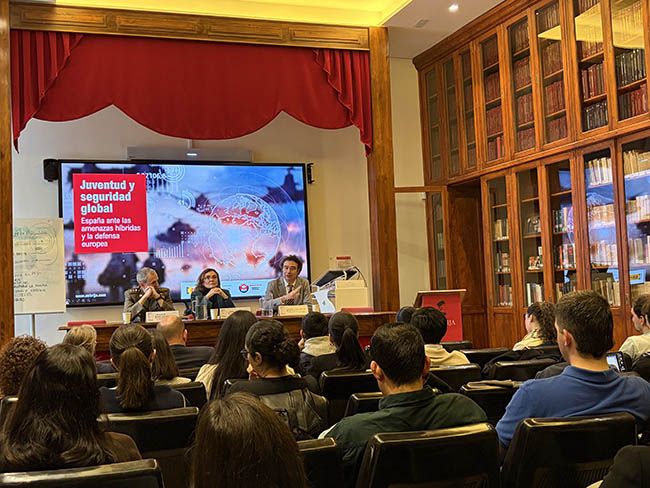
Helsinki España today launched the conference series “Youth and Global Security” at Universidad Nebrija in Madrid. This initiative will travel to several Spanish universities with the aim of bringing young people closer to the analysis of today’s international landscape and the major challenges in global security.
The programme, supported by the Ministerio de Asuntos Exteriores, Unión Europea y Cooperación (Ministry of Foreign Affairs, European Union and Cooperation of Spain), will be held in universities across Valencia, Barcelona, Gran Canaria, Bilbao and Madrid, fostering dialogue between experts and students on the emerging geopolitical order and the role of youth in building more resilient societies.
Opening Session in Madrid
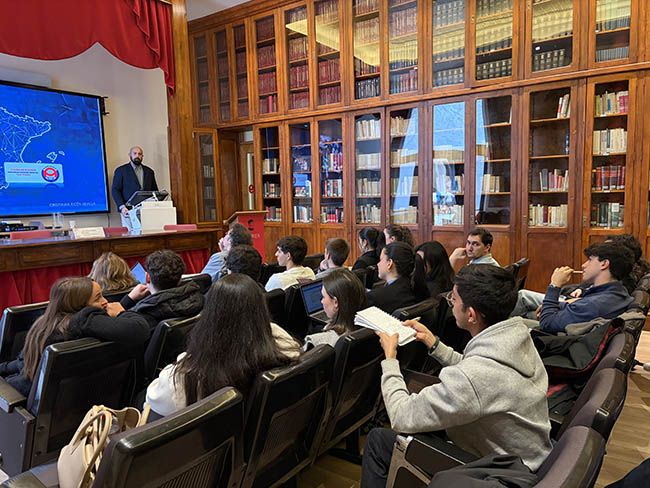
The inaugural session brought together 40 students eager to better understand the current state of international relations and global security.
The opening remarks were delivered by Alfonso López de la Osa Escribano, Dean of the Faculty of Law and International Relations at Universidad Nebrija, and María Jaén, President of Helsinki España, who highlighted the importance of creating spaces for critical reflection among younger generations.
Addressing the New Global Order
The panel featured:
- Mr. Fernando Nogales Álvarez, Senior Advisor on Cybersecurity and Hybrid Threats at the Ministerio de Asuntos Exteriores, Unión Europea y Cooperación.
- Colonel José Luis Calvo Albero, Director of the Coordination and Studies Division at the Ministerio de Defensa (Ministry of Defence of Spain).
- Prof. Dr. Carlos López Gómez, Professor in the Department of International Relations at Universidad Nebrija.
- Mr. Christian Ricós Sevilla, expert in radicalisation and terrorism.
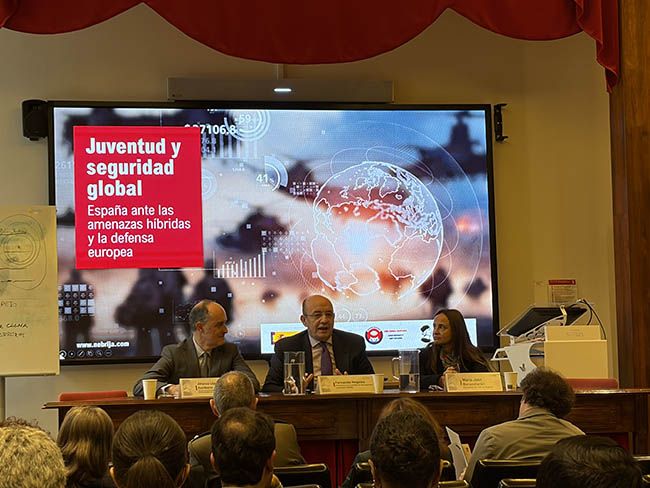
Discussions focused on the geopolitical role of major powers such as the United States, China and Russia, as well as the central role of the United States in global security and Europe’s strategic dependencies.
Speakers also analysed the European Common Security and Defence Policy, the absence of a clearly defined leadership within Europe, the role of NATO, and the potential development of a European security force.
Another key topic was the impact of emerging technologies on modern warfare, including satellite systems such as Starlink, the use of drones, artificial intelligence, and innovative funding mechanisms such as crowdfunding, all of which are reshaping conflict dynamics and global power balances.
The session also referenced the Munich Security Conference, which opens today with the “new world order” at the centre of debate. Around 70 heads of state and government and more than 140 ministers are expected to attend, including China’s Foreign Minister Wang Yi and Presidents Volodymyr Zelenskyy and Emmanuel Macron.
The conference concluded with a discussion on terrorism, radicalisation and the psychology of terror, addressing manipulation processes and recruitment strategies used by extremist organisations.
Speaker emphasised the importance of civic proactivity and awareness of the role each individual plays in society. A strong society, they stressed, is one in which young people are informed, engaged and capable of identifying manipulation and radicalisation processes.
Through this initiative, Helsinki España reaffirms its commitment to fostering a critical, engaged and globally aware generation prepared to face the security challenges that will shape the future of democratic societies.