Protection of Civilians
and International Legal Framework
General Information
This intensive five-day course (40 hours) provides a comprehensive understanding of the responsibilities that, in contexts of armed conflict, fall upon the parties to the conflict, national authorities, and various international actors (humanitarian, development, and peacekeeping) in order to ensure effective and sustainable protection outcomes.
The programme addresses the legal frameworks and obligations under International Humanitarian Law (IHL), including the mandate to protect civilians, which is binding at all times and in all circumstances, particularly for those not directly participating in hostilities, such as women, children, the elderly, and medical and humanitarian personnel. In-class case studies apply the fundamental rules of protection: Distinction, Proportionality, and Precaution.
Through a practical and multidisciplinary approach, participants will learn how to reduce risks and vulnerabilities in contexts of armed violence and strengthen the capacities of affected individuals and communities. The course also covers monitoring and accountability mechanisms, as well as transitional justice. Upon completion, participants will have key tools to understand, compare, and apply different civilian protection approaches used by humanitarian, development, and peacekeeping actors in real-world scenarios.
Course Contents
The course addresses the main legal, political, and operational frameworks for the protection of civilians in armed conflict, combining theory and practice. Key topics include:
- The centrality of protection in humanitarian action
- Protection of civilians mandates in peacekeeping operations
- Responsibility to Protect (R2P)
- International Humanitarian Law (IHL)
- Human Rights Law
- International Criminal Law
- Internally displaced persons and refugees as vulnerable groups.
- International obligations under International Refugee Law.
- Accountability mechanisms and monitoring of violations
- Transitional justice
- Women, Peace and Security (WPS) agenda
- United Nations mandate on children in armed conflict
These contents enable participants to understand the existing legal and operational instruments for the protection of vulnerable populations, as well as the current challenges in their implementation..
Methodology
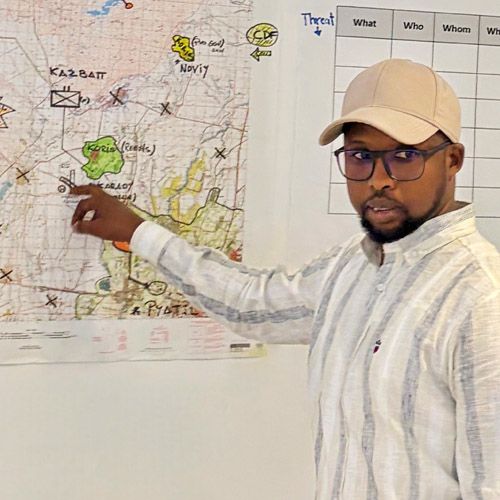
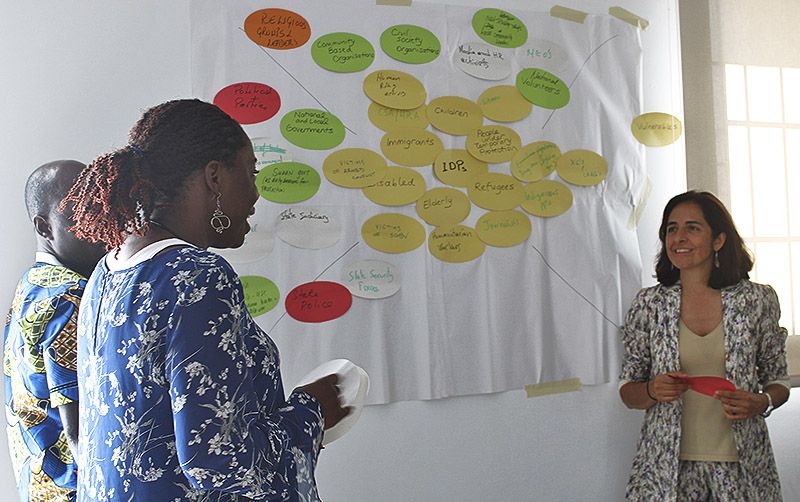
The training combines lectures delivered by active professionals, guided debates and critical analysis sessions, group work and collaborative dynamics, real case studies using conflict mapping, role-playing exercises, and conflict scenario simulations involving decision-making processes and promoting hands-on, participatory learning applied to real-world contexts.
This methodology ensures the development of both solid theoretical knowledge and essential practical skills for working in humanitarian and peace contexts
Format
- Intensive training: 1 week
- Modality: On-site
- Language: English
- Certification: Official Diploma from the International University Center for Peace Missions (IUCPM)
The course is delivered in small groups, allowing for personalized attention and encouraging the active participation of each attendee.
The programme features an international faculty with direct experience in organizations such as the International Committee of the Red Cross (ICRC), the United Nations, as well as legal advisers from international institutions. It also brings together a diverse cohort of participants from different nationalities and professional sectors, fostering the exchange of experiences and the development of global professional networks.
Target Audience
This course is designed for professionals and students interested in the protection of civilians in contexts of armed conflict and humanitarian crises.
- Professionals from international organizations, NGOs, and humanitarian agencies working in the coordination and implementation of humanitarian action and civilian protection.
- Personnel deployed or preparing for peacekeeping missions and other international operations.
- Members of the Armed Forces and defense and security personnel with operational responsibilities.
- Legal professionals (international law, international criminal law, human rights law, transitional justice)
- Public administration officials involved in international cooperation, human rights, or crisis management.
- Professionals engaged in monitoring, documentation, and accountability mechanisms for violations of human rights or International Humanitarian Law.
- Lecturers and researchers in Law, International Relations, Political Science, Security and Defense, or Peace and Conflict Studies.
- Students of International Relations, Political Science, Law, Sociology, International Cooperation, or related disciplines seeking to specialize in direct action in armed conflict settings.
Upcoming Edition
The next edition will take place from May 31st to June 4th, 2027.
REACT
The Protection of Civilians and International Legal Framework course is one of the five modules that make up REACT, Helsinki España’s comprehensive programme designed to train professionals in rapid response, international cooperation, and peacebuilding.
The other modules of the programme cover:
- Conflict Analysis and Transformation
- Tools and Strategies for Sustaining Peace
- Threats to International Peace
- Security Training in Conflict Zones
The modules are generally delivered once a year. Each module can be taken independently in different editions, depending on the participant’s availability. Upon completion of all modules, participants obtain the official OSCE “REACT” certification, which validates comprehensive training as an Expert Team for Rapid Assistance and Cooperation. In addition, those who enroll in more than one module may benefit from a discount.
Information document
General Information ↓
Registration and Further Information:
To register or to resolve any questions, please send us an email to iucpm@helsinkiespana.org including:
- The completed registration form
- Your CV
- A passport-size photo.
If you would like more information, you can write to us at the same email address or send us your inquiry directly through this form:
Upcoming event
Testimonials