OSCE
Organization for Security and Cooperation in Europe (OSCE)
The Organization for Security and Cooperation in Europe (OSCE) is the world’s biggest regional security organization.
The OSCE s an intergovernmental forum for security dialogue and a platform for joint action by its members to improve the lives of their citizens.
The organization’s origins date back to the early 1970s, when the Conference on Security and Cooperation in Europe (CSCE) was established as a multilateral forum for dialogue and negotiation between East and West.
After years of meetings, on August 1, 1975, the CSCE finally agreed and signed the Helsinki Final Act, also known as the Helsinki Accords, a particularly innovative document that established 10 fundamental principles that should regulate the behavior of States towards each other and towards their citizens. These principles are as follows:
- Sovereign equality, respect for the rights associated with sovereignty
- Refusal to use force or threats
- Inviolability of borders
- Territorial integrity of states
- Peaceful resolution of conflicts
- Non-intervention in internal affairs
- Respect for human rights and fundamental freedoms, including freedom of thought, conscience, religion, or belief
- Equal rights and self-determination of peoples
- Cooperation among states
- Fulfillment in good faith of obligations under international law
Until 1990, the CSCE operated through a succession of meetings and conferences on the commitments made by the Participating States. It was not until the end of the Cold War, after the Paris Summit in November 1990, that the CSCE was provided with permanent institutions and operational capabilitie.
After the Budapest Summit of Heads of State held in December 1994, the name of the CSCE was changed to the Organization for Security and Cooperation in Europe, recognized worldwide by its acronym OSCE.
The OSCE’s comprehensive approach to security, which includes the politico-military, economic, environmental, and human dimensions, as well as its inclusive nature, helps to overcome differences and build confidence among States through cooperation in conflict prevention, crisis management and post-conflict rehabilitation.
In military issues, it is committed to greater openness, transparency and cooperation, and has developed the world’s most advanced system of arms control and confidence-building measures.
Economic and environmental issues are also fundamental factors when it comes to promoting security. The OSCE helps by supporting good governance, dealing with corruption, raising environmental awareness, sharing natural resources, and handling waste in an environmentally friendly way.
Human rights and fundamental freedoms are the foundation of a stable society. The OSCE assists its participating States in developing democratic institutions; conducting free and democratic elections; guaranteeing human rights, media freedom, the rights of national minorities and the rule of law; and promoting tolerance and non-discrimination.
On a wider level, the OSCE deals with security challenges that present a transnational threat, such as climate change, terrorism, radicalization and violent extremism, organized crime, cybercrime and trafficking in drugs and arms, as well as trafficking in human beingsg.
OSCE and the Helsinki Human Rights Committees
The principles of the Helsinki Final Act dedicated to the respect of human rights and fundamental freedoms led to the creation in Moscow of the Helsinki Group, a non-governmental organization aimed at monitoring the implementation of the Helsinki Accords.
The Helsinki Group expanded with the establishment of several regional and national committees, including Helsinki España – Human Dimension. Since its founding in 1992, Helsinki España has been committed to promoting and disseminating the principles of the Helsinki Final Act, working to protect and defend human rights through education.
In parallel, the OSCE Office for Democratic Institutions and Human Rights (ODIHR), established in 1991, serves as the official OSCE body responsible for strengthening the human dimension at the intergovernmental level. While the Helsinki Committees are independent civil society organizations that document and report human rights violations, the ODIHR supports OSCE participating States through election observation, technical assistance, promotion of democracy, and cooperation with civil society, including the Helsinki Committees. This collaboration reinforces the implementation of human rights commitments across the region.
OSCE and REACT course
In 1999, during the Istanbul Summit, OSCE participating States signed a key document to strengthen the organization’s human dimension. It stated explicitly: “Create Rapid Expert Assistance and Cooperation Teams (REACT), enabling the OSCE to respond promptly to requests for assistance and the deployment of large-scale civilian operations on the ground.” This agreement laid the foundation for specialized teams capable of rapid intervention in crisis situations and peace missions.
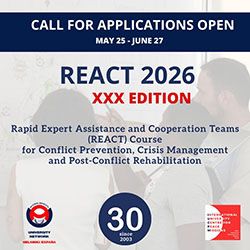
In response to this mandate, since 2003 Helsinki España has been training professionals from NGOs and international organizations to participate in peace missions and high-risk civilian operations, providing training in conflict analysis, civilian protection, stress management, and gender perspectives.
In this way, Helsinki España directly contributes to the implementation of the Istanbul Document’s commitments, strengthening security, the protection of human rights, and the resilience of vulnerable communities.
The OSCE and Spain
Spain has been one of the founding countries of the organization since its beginnings and has had permanent representation in Vienna since 1994.
Spain has played a prominent role in the OSCE since its creation through the initiatives it has promoted within the organization.
Spain’s priorities include the involvement of young people in security issues, women, peace and security, the fight against terrorism and the dignity of its victims, the promotion of human rights, the consolidation of democratic institutions and environmental policies.

Upcoming event