Conflict Analysis &
Conflict Sensitivity Programming
General Information
This intensive five-day course (40 hours) focuses on the analysis of situations of tension and the use of context-sensitive programming tools, including an approach based on the Humanitarian–Development–Peace (HDP) Triple Nexus. Particular emphasis is placed on understanding the actors involved, power dynamics, and how interventions and mediation efforts interact with the environments in which they are implemented.
Participants will learn to identify the causes, actors, and dynamics that generate tensions, taking into account gender dimensions and other identity-based exclusion factors. They will also develop the skills to design programmes that promote equality and inclusion as an integral part of their planning, applying strategies of positive communication, mediation, negotiation, and dialogue.
The module also incorporates the application of the Theory of Change (ToC) to plan effective and sustainable interventions, ensuring that programmes respond to the real needs of communities and foster social resilience.
Contents
- Analysis of actors and conflict dynamics: causes, stakeholders sustaining factors, and determinants of exclusion.
- Context-sensitive programming: designing programmes that address identity mechanisms, vulnerabilities, and leverage points to mitigate tensions.
- Communication strategies: nonviolent communication, inclusive and positive language, mediation, negotiation, and dialogue.
- Strategic planning: application of the Theory of Change (ToC) and the HDP approach for sustainable and effective interventions.
Methodology
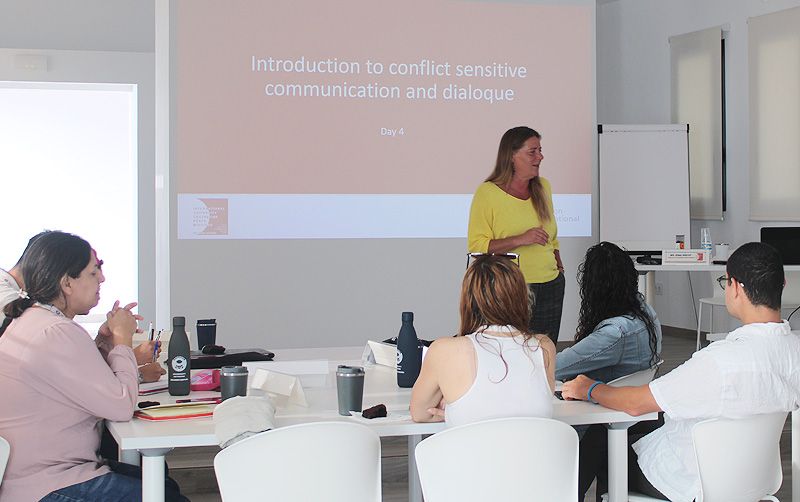
The methodology combines expert lectures, structured debates, collaborative group work, case study analysis, role-playing exercises, and simulations, promoting hands-on, participatory learning applied to real-world contexts.
Format
- Intensive training: 1 week
- Modality: On-site
- Language: English
- Certification: Official Diploma from the International University Center for Peace Missions (IUCPM)
The course is delivered in small groups, allowing for personalized attention and encouraging the active participation of each attendee.
The programme features an international faculty with extensive experience in field missions, NGOs, and international organizations. It also brings together a diverse cohort of participants from different nationalities and professional sectors, promoting the exchange of experiences and the development of global professional networks.
Target Audience
This course is designed for professionals and students with an international vocation who are interested in conflict management in complex contexts. It is particularly relevant for:
- Professionals from international organizations, NGOs, and humanitarian agencies working in conflict prevention and transformation.
- Professionals involved in inclusive development programmes, Women, Peace and Security (WPS) initiatives, or Youth, Peace and Security (YPS) programmes.
- Programme managers in development and cooperation seeking to integrate conflict sensitivity and the Humanitarian–Development–Peace (HDP) Triple Nexus into their projects.
- Facilitators, mediators, and reconciliation specialists interested in applying these tools in international contexts.
- Lecturers and researchers in Human Rights, Sociology, and Political Science.
- Students of International Relations, Political Science, Sociology, and Peace studies who wish to acquire practical skills in conflict analysis and conflict-sensitive programming.
Upcoming Edition
The next edition will take place from May 24th to May 28th, 2027.
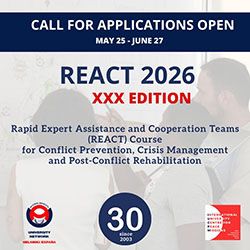
REACT
The Conflict Analysis and Transformation course is one of the five modules that make up REACT, Helsinki España’s comprehensive programme designed to train professionals in rapid response, international cooperation, and peacebuilding.
The other modules of the program include:
- Protection of Civilians and the International Legal Framework
- Tools and Strategies for Sustaining Peace
- Threats to International Peace
- Security Training in Conflict Zones
The modules are generally delivered once a year. Each module can be taken independently in different editions, depending on the participant’s availability. Upon completion of all modules, participants obtain the official OSCE “REACT” certification, which validates comprehensive training as an Expert Team for Rapid Assistance and Cooperation. In addition, those who enroll in more than one module may benefit from a discount.
Information document
General Information ↓
Upcoming event
Registration and Further Information:
To register or to resolve any questions, please send us an email to iucpm@helsinkiespana.org with:
- The completed registration form
- Your CV
- A passport-size photo.
If you would like more information, you can write to us at the same email address or send us your inquiry directly through this form:
Testimonials