Hostile Environment Awareness
Training (HEAT)

What is HEAT?
The HEAT training is an intensive five-day program designed to prepare professionals deploying to high-risk environments or conflict zones. This training develops automatic response skills in critical situations, situational and personal security awareness, as well as emotional and risk management in real-world scenarios that test resilience, judgment, and teamwork. Participants gain practical tools to make quick and safe decisions, protect themselves and their colleagues, and operate effectively under pressure in international missions within hostile environments.
Background
HEAT (Hostile Environment Awareness Training) was developed in the 1990s by international humanitarian organizations and security consultancies for civilian and humanitarian personnel deploying to high-risk environments, particularly in conflict or unstable areas.
Since 2003, Helsinki España has been delivering this training through the IUCPM, and over more than 20 years of experience, has trained over 600 professionals.
The HEAT course is integrated into our REACT program (Rapid Expert Assistance and Cooperation Teams for Conflict Prevention, Crisis Management, and Post-Conflict Rehabilitation) as safety training for work in Peacekeeping Missions, although we also offer independent editions for those who need the training on its own.
While not all organizations formally require HEAT, it is highly recommended for anyone working in field operations in conflict or high-risk zones. For agencies such as the UN, OCHA, Médecins Sans Frontières, UNHCR, and the International Red Cross, HEAT or equivalent training is often a prerequisite for deployment in high-risk missions.
Although technicians, aid workers, journalists, correspondents, or diplomats could technically deploy without this training, doing so without HEAT is strongly discouraged for their own safety and may limit access to certain field assignments.
Course Objectives
The HEAT course is designed to prepare professionals working in international development, humanitarian assistance, human rights, journalism, and other sectors operating in complex environments to work more safely, effectively, and resiliently in high-risk settings.
Upon successful completion of the course, participants will be able to:
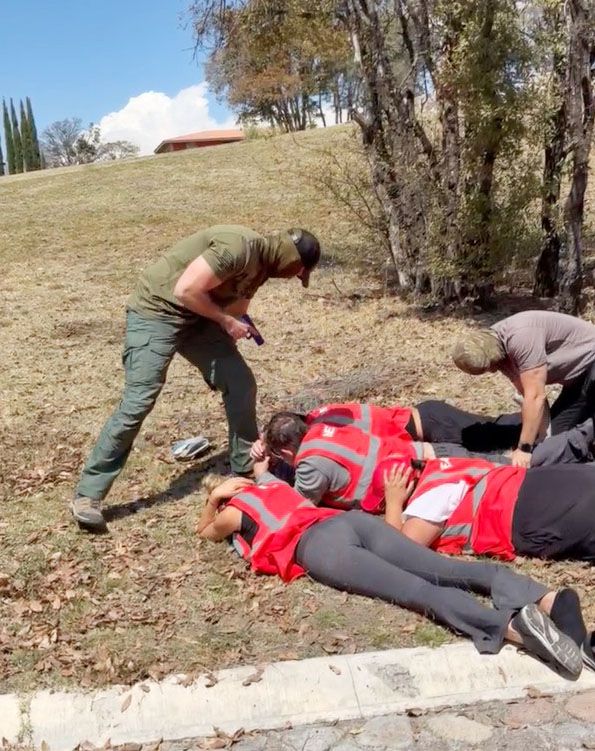
- Apply practical safety, survival, and emergency response skills through realistic exercises and simulations based on situations commonly encountered in the field.
- Develop practical habits and tools to protect both themselves and their team while maintaining the ability to operate effectively under pressure and uncertainty.
- Identify threats, assess risks, and implement appropriate preventive measures before, during, and after deployment in insecure or unstable environments.
- Respond effectively to critical incidents such as armed attacks, kidnappings, civil unrest, emergency evacuations, accidents, and medical emergencies.
- Strengthen personal resilience and decision-making skills in situations involving stress, uncertainty, and operational pressure.
- Improve communication and coordination during crises, working effectively with national and international teams as well as other actors operating in the field.
- Increase the confidence, preparedness, and adaptability required to carry out professional activities in high-risk environments.
Content of the training:
- Awareness of Threats and Risk Management
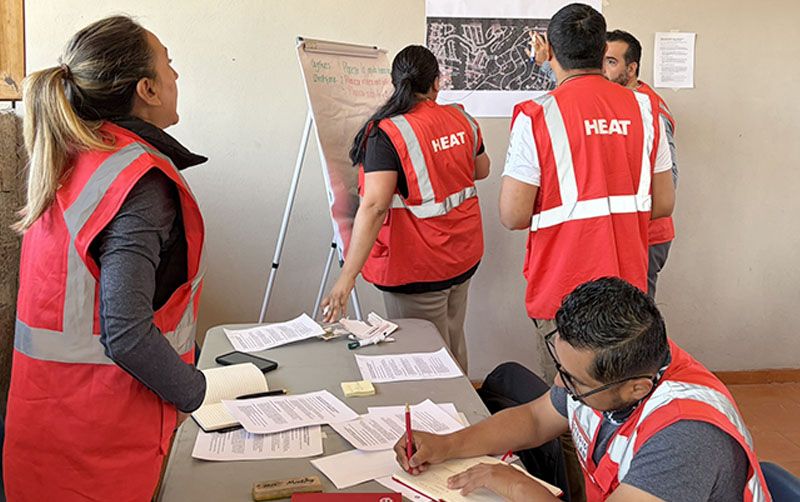
- Operational Safety Planning.
- Self-Defense Tactics.
- Response to Sexual Assault Attempts.
- Robbery Prevention and Response.
- Tactical First Aid.
- Casualty Evacuation.
- Emotional Regulation, Stress Management and Resilience.
- Conflict Management: Persuasion, Negotiation and De-escalation.
- Orientation, Map Reading and GPS Navigation.
- Checkpoint and Roadblock Navigation: Managing Vehicle Inspections and Secure Passage.
- Weapons, Mines, Improvised Explosive Devices (IEDs) and Unexploded Ordnance (UXO).
- Hide, Run, Fight (Active Shooter Response).
- Travel Security: Protection and Safety Procedures for Vehicle Transport.
- Residential Security: Personal Safety and Protection at Accommodation.
- Managing Threats in Crowds, Demonstrations, Protests and Riots.
- Kidnapping and Hostage Survival.
All course content is tailored to strengthen the safety, preparedness, and operational effectiveness of professionals working in international development, humanitarian assistance, human rights, and the non-profit sector in complex and high-risk environments.
Instruction Team
Our HEAT is delivered by a multidisciplinary team of highly qualified professionals who have built their careers in some of the most demanding environments within the fields of security, emergency healthcare, and crisis management.
Our instructors include security professionals, healthcare practitioners, and trauma psychology specialists, all of whom bring extensive operational experience from both civilian and military settings. In addition, they have significant experience training and preparing humanitarian personnel, understand the challenges faced by those working in the field, and tailor training exercises and scenarios to the operational realities of humanitarian and non-profit organisations.
- Security and Risk Management: led by professionals from elite military units and security services with experience in special operations, international deployments, and complex high-threat environments. Their backgrounds include assignments in different regions of the world, as well as the protection of senior government officials, institutional representatives, political leaders and business executives. This expertise is adapted to the operational needs of aid workers, humanitarian personnel, and professionals working in challenging field environments.
- Healthcare in Hostile Environments: delivered by healthcare professionals with first-hand experience in emergency medical services, disaster response, mass-casualty incidents, and humanitarian crises. Their practical expertise ensures that participants learn procedures and protocols drawn from real-world emergency situations.
- Emotional Wellbeing and Resilience: delivered by a trauma psychology specialist with experience supporting professionals exposed to critical incidents and high-pressure environments. The training provides practical tools to strengthen resilience, manage stress effectively and maintain operational performance under pressure.
The combination of operational experience, technical expertise, and instructional capability ensures practical, up-to-date training based on lessons learned from real crises, emergencies, and hostile environments.
All course content is tailored to strengthen the safety, preparedness, and operational effectiveness of professionals working in international development, humanitarian assistance, human rights, and the non-profit sector in complex and high-risk environments.
Participant profile
This training is designed for individuals who, due to their professional duties or personal circumstances, may find themselves exposed to hostile or high-risk environments.
The course is especially useful for:
- Humanitarian and international cooperation personnel, particularly those working in rural areas or regions with the presence of armed actors.
- Journalists covering territorial conflicts, organized crime, illegal mining, environmental crises, or social protests.
- Public officials and community leaders involved in human rights defense or land restitution processes.
- Staff of grassroots organizations and local NGOs, especially in hard-to-reach areas.
- Environmental and land defenders operating in regions affected by illegal economies.
- Members of international missions, diplomatic personnel, and human rights observers.
- Emergency response, disaster management and risk reduction teams.
- Populations exposed to political, social, or economic vulnerabilities, including displaced persons or those at risk of socio-political violence.
- Individuals involved in contexts impacted by organized crime, political unrest, or environmental conflict.
This course is also recommended for young professionals or students preparing to work in the field or in conflict-affected areas.
Certification
Participants who successfully complete the training will receive a HEAT Certificate issued by the International University Centre for Peace Missions (IUCPM) of HELSINKI ESPAÑA.
This certificate confirms that the participant has successfully completed specialised training in safety and survival in hostile environments, acquiring practical knowledge and skills to prevent risks, respond to critical incidents, and operate safely in complex settings while protecting both themselves and their team.
HEAT is a widely recognised standard used by humanitarian organisations, international development agencies, international organisations, and other entities that deploy personnel to high-risk environments.
In the fields of international development and humanitarian assistance, security preparedness is not an added value: it is a professional necessity. Organisations have a duty of care towards their personnel and must ensure that those working in high-risk environments are equipped with the knowledge and skills needed to respond safely and effectively to critical situations. For this reason, an increasing number of international organisations, NGOs, and agencies deploying personnel to the field regard HEAT training as an essential preparation before taking on responsibilities in insecure or unstable environments. In many recruitment processes, holding a HEAT certificate can make the difference between a candidate who is prepared for field deployment and one who is not.
Beyond strengthening a professional profile, HEAT provides practical tools that can prove decisive for personal safety and effective response during crises and emergencies.
Participants are encouraged to renew their HEAT training every five years to ensure that their knowledge and skills remain current and aligned with the demands of increasingly complex and high-risk operating environments.
Small Groups and Training Tailored to Every Context
At HELSINKI ESPAÑA, we are committed to delivering high-quality HEAT training through small group learning, ensuring an active, practical, and truly personalised experience. This approach allows each participant to receive close support from the instructional team and develop the course competencies while taking into account their physical capabilities, previous experience, and individual needs.
We currently operate from training hubs in Spain and Mexico, where we typically organise two or three HEAT courses per year at each location. In addition, our instructor team is internationally deployable and can travel to deliver training in other countries or locations according to the needs of partner organisations.
We also design and deliver customised HEAT courses for NGOs, international organisations, universities, media professionals, companies, and non-profit organisations. These programmes are tailored to the specific risks, operational context, and professional profile of each group, ensuring that training scenarios and exercises reflect the realities participants may face in the field.
If you represent an organisation and require HEAT training adapted to your team, we would be pleased to discuss your needs. We design bespoke programmes focused on the real challenges and risks of your operational environment.
Why choose the HEAT course with Helsinki España?
Our HEAT course offers the most comprehensive training, featuring the highest number of simulated situations to prepare participants for real-life challenges.
Our trainers are highly qualified professionals from both civilian and military backgrounds, with extensive experience in international missions and firsthand knowledge of the scenarios being simulated.
Our Helsinki España team provides constant support throughout the course, accompanying participants to ensure their well-being and assisting with any issues that may arise, offering a level of care and assistance beyond the training itself.
Our course offers the best value for money, combining top-quality training with affordable pricing.
Open calls for applications
-
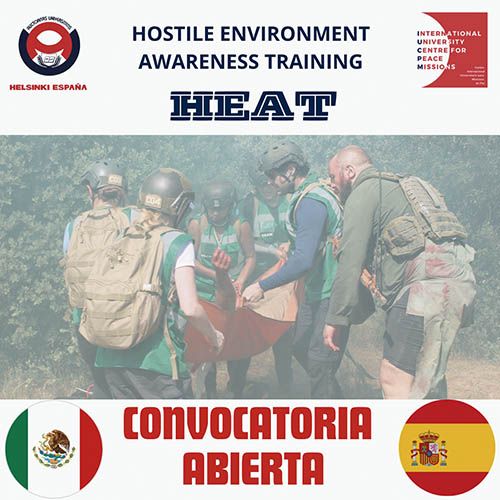
Mexico: October 24–28, 2026, in Spanish
-
Spain: November 14–18, 2026, in English and Spanish
-
Colombia: November 21–25, 2026, in Spanish
Professionals trained in Security
Professionals trained in Security
Registration and More Information:
To register, please send us an email at iucpm@helsinkiespana.org with:
- The completed registration form
- Your CV
- A passport-size photo.
If you would like more information, you can write to us at the same email address or send us your inquiry directly through this form:
HEAT Alumni Testimonials








Upcoming event
Trusted by These Organizations