New HEAT training dates. Mexico. Colombia. Spain.
Would you know when you need to leave a building? How would you react if an apparently normal situation suddenly began to develop into a threat? Would you know how to recognize signs that could precede a kidnapping? And what would happen if, despite all preventive measures, you were captured?
These are uncomfortable questions. Precisely for that reason, we need to ask ourselves them before we are forced to answer them.
Many organizations have security protocols, emergency plans and established procedures. However, in a real situation, especially when there is fear, confusion or time pressure, having a document does not guarantee that a person will know what to do.
Kidnapping may not be the most frequent risk a person can face, but its consequences can be extraordinarily serious. Avoiding the subject for fear of causing alarm does not contribute to building a genuine security culture.
In 2025, Mexico recorded 550 victims of extortion kidnapping in the common jurisdiction, according to the Executive Secretariat of the National Public Security System (SESNSP). In Colombia, the National Police recorded 651 kidnapping cases, 477 of which were classified as extortion kidnappings.
These are risks that cannot be ignored.
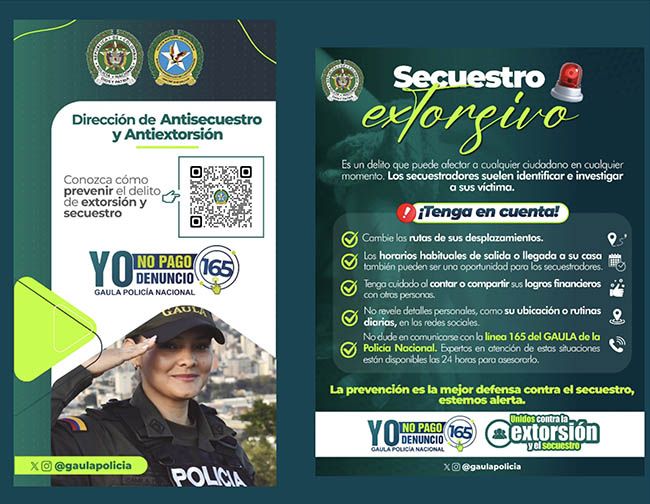
In Colombia, for example, the National Police, through GAULA, carries out specific actions to address kidnapping and extortion. But one aspect is particularly significant: an important part of its work is preventive, through awareness campaigns, self-protection measures and early identification of risks.
Prevention is not only about reacting when a crime occurs. It is also about preparing people before it happens.
Prevent before you react
Las organizaciones que trabajan en contextos internacionales, zonas remotas o entornos potencialmente hostiles suelen disponer dOrganizations working in international contexts, remote areas or potentially hostile environments often have security policies and procedures in place. But between a written procedure and an effective response there is one essential element: the person who has to make the decision.
- An evacuation may require leaving a building quickly.
- A threat may require changing travel or movement plans.
- An armed violence situation may require recognizing the danger and finding a safe way out.
- A kidnapping attempt can unfold within seconds.
In all these situations, there is something in common: there is no time to open a manual and start learning. The training must have happened beforehand.
Good preparation does not mean living in constant fear of threats. It means developing habits, knowledge and judgment that enable people to recognize risky situations and make better decisions.
A prepared person may be better equipped to identify warning signs and unusual behaviour, reduce exposure to risk, adopt self-protection measures, respond to a security threat, evacuate a building or area, act in an active shooter situation, make decisions under stress, respond to a kidnapping attempt, cope emotionally with captivity, and contribute to the safety of colleagues and the organization.
The aim is not to turn every employee, volunteer or staff member into a security specialist. It is about providing them with the tools to recognize, decide and act.
Security must also be trained
Protecting people requires organizations to take active responsibility. For a company, NGO, public institution, university, international organization or any entity sending people into risk environments, protecting teams should not be limited to creating a protocol or providing an emergency telephone number.
In a crisis situation, stress can affect perception, communication and decision-making. Uncertainty can lead to hesitation or paralysis. And a person who has never trained for a particular response may struggle to act when it matters most.
That is why training for hostile environments must go beyond theory. It should allow participants to practice, experience scenarios, make decisions and learn to manage pressure in a controlled environment.
That is precisely the purpose of HEAT (Hostile Environment Awareness Training).
It is not about teaching people to be afraid. It is about teaching them to be prepared.
Security cannot be improvised. It must be trained.
In 2026, Helsinki España is offering the following HEAT training dates:
🇲🇽 Mexico — 24–28 October 2026
🇪🇸 Spain — 14–18 November 2026
🇨🇴 Colombia — 21–25 November 2026