Oct 20, 2021 | Youth for Youth
On Monday, October 25, the canarian youth enrolled in Youth for Youth began the training course on Human Rights. This course will take place until Friday, October 22, in the Nexo building located on the Tafira campus, thanks to the collaboration of the University of Las Palmas de Gran Canaria (ULPGC). The president of Helsinki Spain, María Jaén, and the Vice-Chancellor for Students, Alumni and Employability of the ULPGC, David Sánchez, opened the course this Monday. (You can see the news at the ULPGC’s web)
Throughout the week, the students will be trained on human rights, sustainable development goals and other related subjects such as gender equality, mental and emotional health, environment protection, migration, refugees and asylum, the fight against bullying. and the responsible use of social networks. The course is given by experts in the different subjects, having the students the opportunity to recreate some of the dynamics that they will later put into practice in the schools.
It will be an intense but crucial week to train and transmit what you have learned to the little ones!


Sep 9, 2021 | Education, Human Rights, Youth for Youth
We are starting strong this course with our human rights education project in Madrid, the Canary Islands and Malaga. “Youth for Youth” is a project based on the education as a fundamental tool for mobilization and social transformation, which tries to raise awareness about social problems, promote debate and critical thinking among the youth and childhood. Helsinki Spain is launching this project with the support of the Community of Madrid and the Ministry of Health.
Don’t let this opportunity slip away! Train yourself with experts and civil society organizations in the defense of human rights and develop workshops through a participatory methodology in schools.
Training date:
Click on the poster and SIGN UP!
If you are interested, you can check more information in Youth to Youth.


Mar 26, 2021 | Gender equality, Human Rights, Talleres, Youth for Youth
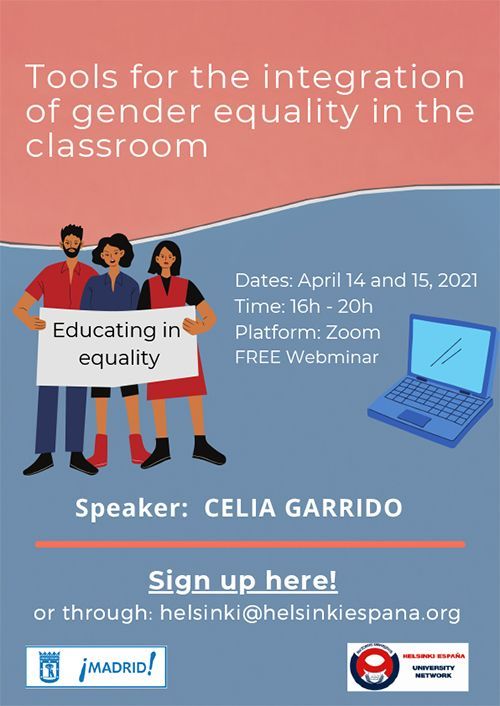
Free awareness Webminar for Teaching Staff in which the following topics will be discussed:
- Explanation of the gender system and its repercussions on the staff and on the social structure.
- Effects the gender division system on the educational system.
- Once all the information has been presented, tools to promote a positive social change inside the classroom will be offered.
Goals
Providing the teaching staff with the necessary tools to identify inequalities in education, and to develo a non-sexist education that provides values of equality and helps to overcome discrimination ans social prejudice. Providing with the necessary resources to carry out egalitarian educational practivces in the classroom as well.
Our guest speaker will be Celia Garrido, who has previously collaborated with us in different formations with gender perspective. Celia is a consultant, trainer and expert on gender equality and violence.
- She was part of the project to prevent sexist violence in education “not only punches hurt”.
- She is also part of the teaching staff of the Master in Maltrato y violencia de género – UNED.
- She designs and develops awarenes, reflection and training workshops for different public and private entities.
For the 2021 edition, due to the health situation we are facing nowadays, the webminar will be carried out through the ZOOM platform.
Dates: Wednesday the 14th and Thursday the 15h of April, 2021
Time: 4PM-8PM
Cost: FREE”

Mar 26, 2021 | Employment guidance and social collaboration, Human Rights, Sustainable Tourism, Youth for Youth
The Camino de Santiago is an experience that, as in the past, traveling or pilgrimage, becomes a means to obtain knowledge, moments, being also an adventure of personal transformation in itself where values such as freedom, trust, solidarity or the effort to achieve a goal. For this we must bear in mind that the person who walks has all the time in the world, is free to spend hours visiting a town or going around a mountain, following the course of a river or going up a hill, after which they end up looking at the horizon the towers of the Cathedral of Santiago.
With the Team Innovation 2021 Project we seek to create an interuniversity debate that revolves around issues that are on the order of the day such as the 2030 Agenda, Human Rights and Sustainable Tourism, shaping possible responses in view of the future of the Camino de Santiago itself. Where is the Camino de Santiago heading? Trying to answer this question is part of the collective work among young university students who participate by contributing their experiences both in the online study process, as well as in the actual completion of the Camino de Santiago, where they will share moments along the way and in the shelters, culminating everything the process in a university forum at the University of Santiago de Compostela in which the knowledge found and the possible practices that can be carried out in the Future of the Camino de Santiago are transmitted.
But beyond the critical knowledge that the students acquire, they also gain in a personal feedback between the nature that surrounds the Camino de Santiago in its different stages, the local communities through which they travel and the cultural-historical heritage of which they are Can enjoy. All this is intertwined in the own person in a formula of knowing oneself.
A colleague who participated in previous editions commented to us:
“The experience of the Camino was what taught me the idea that the difficulty of being away from our homes and everything that we see as something normal in our daily lives, that feeling of finding ourselves as strangers in unknown places, to see in the faces of some an attitude of fear or indifference and the opposite, to receive the hospitality and solidarity of the people almost daily “


Mar 25, 2021 | Youth for Youth
The objective of the course on ‘Gender Equality and Human Rights’ is to provide teachers with the necessary tools to identify inequalities in the educational field, and to develop a non-sexist education that provides values of equality and contributes to overcoming discrimination and social prejudices.
Similarly, this course is aimed at providing the necessary resources to carry out equal educational practices in the classrooms.
To date, we have trained more than 100 teachers in gender equality and human rights.

Feb 16, 2021 | Employment guidance and social collaboration, Youth for Youth
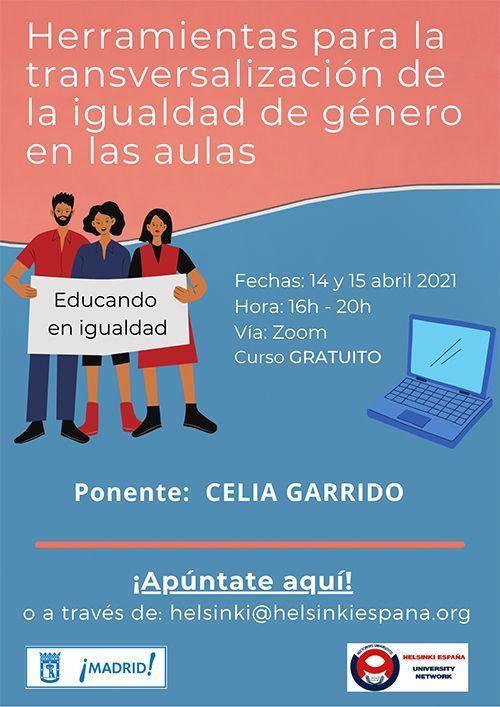
A volunteering project organized by Helsinki-España, in collaboration with Ayuntamiento de Madrid, where you will receive training in Human Rights by the hand of experts in order to attend to schools and raise awareness among the students through a participatory methodology.
Training starts in March (22th to the 26th in Asturias) (15th to the 19th in Madrid). Join us and participate!!
Contact us at helsinki@helsinkiespana.org or sign up her.
If you are interested, you can check more information in Youth to Youth.