May 27, 2025 | Human Rights
The international peacebuilding programme brings together participants from 18 countries, supported by the Ministry of Defence, Fundación Carolina, and the Alfaz del Pi City Council.
REACT 2025 Training Program Kicks Off in Alfaz del Pi with National and International Institutional Support
This Monday, May 26, the opening ceremony of the REACT course (Rapid Expert Assistance and Cooperation Teams) took place in El Albir, Alfaz del Pi (Alicante). Organized by Helsinki España, REACT is an international training program focused on peacebuilding and humanitarian action.
The event was attended by distinguished civil and military authorities, including:
- Colonel José Luis Calvo Albero, Director of the Security and Defense Coordination and Studies Division at the Spanish Ministry of Defense;
- Mr. Juan José Martín Martín, Head of the Training and Technological Development Department at Fundación Carolina;
- Ms. Isabel María Muñoz Llorens, Councilor for Cooperation and Volunteering of the Municipality of l’Alfàs del Pi;
- Ms. María Jaén Barandiarán, President of Helsinki España, who officially welcomed the participants on behalf of the organizing team;
Councilor Isabel Muñoz welcomed the international students to Alfaz del Pi, “a town with a predominantly international population,” and expressed her hope that REACT 2025 would not only be a space for learning, but also a platform for connection and peacebuilding. She encouraged participants to explore the town, its beach, lighthouse, and beautiful landscapes.
Colonel Calvo Albero emphasized that “we are living in a time of war, and we will need a massive effort in stabilization, disarmament, social reconstruction, and peacekeeping—and we must prepare for that now.” He highlighted the importance of programs like REACT in training future peace professionals.
Mr. Juan José Martín Martín, from Fundación Carolina—which has awarded scholarships to Ibero-American students to attend REACT for over 15 years—announced that the scholarship program would be expanded in 2026, allowing more individuals to receive training in human rights and conflict resolution. He also highlighted the high female participation in this edition as a significant step toward equity in the international arena.
María Jaén Barandiarán, President of Helsinki España, thanked the institutional support of the Municipality of Alfaz del Pi for hosting the course and providing its facilities, the Ministry of Defense for enabling the participation of military personnel, and Fundación Carolina for its ongoing support. She also praised the courage and commitment of the participants who have chosen to dedicate themselves to conflict resolution and international peacebuilding.
REACT is Helsinki España’s flagship international training program in peacebuilding: a comprehensive, 220-hour, in-person course on conflict prevention, crisis management, and post-conflict rehabilitation. Launched in 2003 at the proposal of the Spanish Ministry of Foreign Affairs and Cooperation, with the support of the OSCE and the United Nations, its goal is to equip selected professionals with the skills and competencies required to work in international peace operations.
Now in its 29th edition, REACT is a consolidated and well-regarded program in the fields of peacebuilding and humanitarian action. Over the past 20+ years, it has trained hundreds of professionals who now work with organizations such as the United Nations, OSCE, European Union, Red Cross, and NGOs operating in conflict zones and humanitarian crisis settings around the world.
REACT 2025 runs from May 26 to June 28 and brings together professionals and future experts in humanitarian action, peacebuilding, and human rights from 18 different nationalities, including countries such as Sudan, Austria, Brazil, Cameroon, Lebanon, Syria, and the Netherlands. The faculty is composed of over 20 instructors from 8 different nationalities, including the United States, Sweden, and Germany.
Over five weeks of intensive training, participants will explore key topics such as conflict analysis and prevention, civilian protection, international humanitarian law, disarmament and reintegration, countering disinformation, field security, gender perspective, and stress management in hostile environments. The course will conclude with a practical week of outdoor field training using the HEAT (Hostile Environment Awareness Training) methodology, designed to prepare participants to operate safely and effectively in high-risk situations.


May 27, 2025 | Human Rights
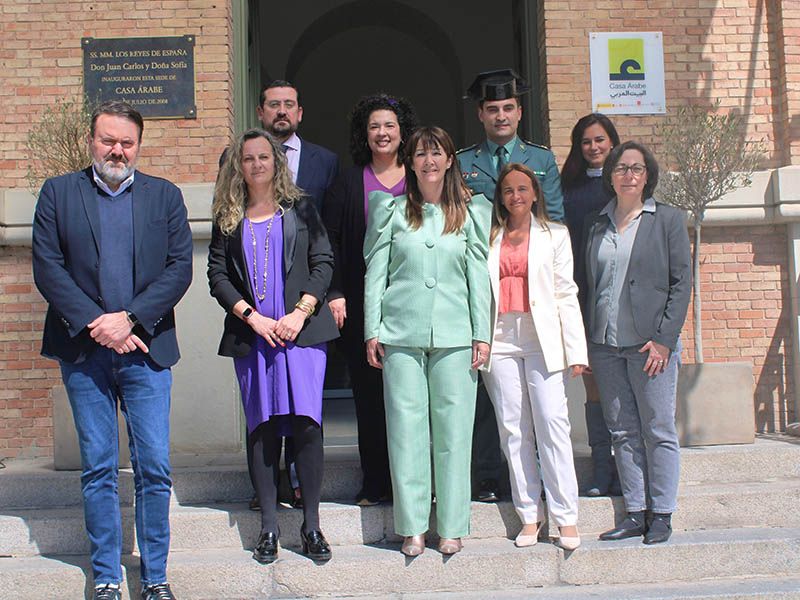
On April 7th, we held the 2025 University Seminar on Human Trafficking at Casa Árabe (Madrid), under the slogan “Break the darkness, face the truth. Join the conversation.” More than 150 people participated both in person and online, raising their voices against human trafficking, sexual exploitation, and prostitution, and highlighting the key role of youth in the defense of human rights.
It is essential to make trafficking visible, raise awareness about sexual exploitation and prostitution, and promote the engagement of young people in the defense of human rights.
We were honored to hear from professionals with outstanding careers in the fight against this serious violation of rights:
- Claribel De Castro Sánchez – National University of Distance Education (UNED)
- Captain Fernando Hernández Rodrigo – Human Trafficking Division, Spanish Civil Guard
- Marta González Manchón – Fundación de Solidaridad Amaranta
- Eva Márquez – Diaconía
- Rocío Mora – Apramp
With the institutional support of:
- Rubén Pérez Correa – State Secretariat, Ministry of Youth and Children
- Maria Jaen – President of Helsinki España – Dimensión Humana
- Miguel Moro – Director General of Casa Árabe
We are especially grateful for the participation of the Universidad Estatal de Bolívar (Ecuador), where several Human Talent Management classes joined the seminar as a group.
The event was organized by the Institutional Relations team of Helsinki España, coordinated by Beatriz Boris, with the support of the Ministry of Foreign Affairs, European Union and Cooperation, and in collaboration with Casa Árabe.
Oct 10, 2024 | Education, Human Rights
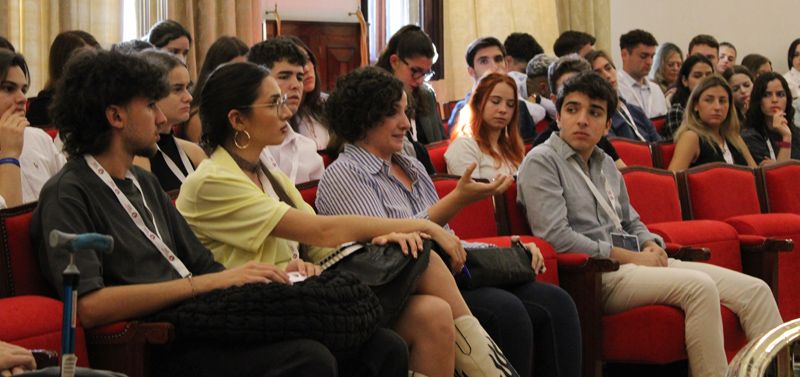
“Challenges and Threats to International Security: Building Critical Thinking from the University” is an event funded by the General Secretariat for Defense Policy of the Ministry of Defense. Its objective is to enhance knowledge about current challenges and threats to international security, encourage analysis and critical thinking, and engage young people in key issues in today’s international security. The sessions will be led by representatives from the Ministry of Defense, the Higher Center for National Defense Studies, the Spanish Institute for Strategic Studies, and security experts.
If you’re interested in delving into the major global threats that jeopardize peace and international security, understanding the impact of disinformation on contemporary democracies through the use of social media, and learning about the risks associated with new hybrid warfare strategies, you shouldn’t miss this activity.
With a duration of approximately 5 hours, there will be three sessions led by experts, followed by one university debate session. The project focuses on fostering critical thinking to enhance the analytical and argumentative abilities of the participants. To achieve this, at the end of the event, different groups will be formed among the attendees to discuss issues previously raised during the event.
The event will take place on Wednesday, October 23rd, from 08:30 AM to 02:00 PM at the University of Nebrija.
Register here or via email at iucpm2@helsinkiespana.org
Apr 19, 2024 | Education, Human Rights, REACT
The Environmental Education Center (CEA) Carabineros de l’Alfàs del Pi will host from May 27 to June 22 the twenty-eighth edition of REACT, a five-week training program on peace processes and conflict prevention, organized by the association Helsinki Spain.
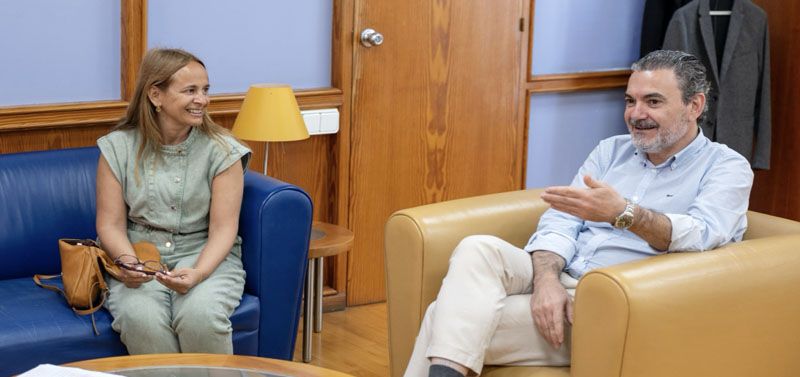
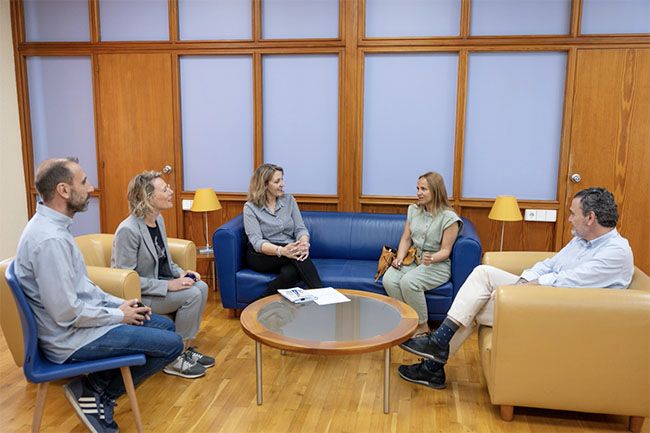
he mayor of l’Alfàs del Pi, Vicente Arques, has received at City Hall the president of Helsinki Spain, María Jaén Barandiarán, to learn the details of this training program for the fourth consecutive year will be held in l’Alfàs del Pi. A meeting which was also attended by the councilors of Cooperation and Volunteering, Isabel Muñoz, and International Residents, Martine Mertens, and the mayor of Culture, Manuel Casado.
This program trains professionals from different fields interested in improving their knowledge in conflict prevention, crisis and post-conflict management, rehabilitation and development, as well as their practical skills for field work in international peace operations.
The program uses a variety of methodologies, including presentations and lectures, discussions, group work, practical and advanced role-playing sessions, outdoor activities and simulation exercises.
REACT was created in 2003 with the objective of preparing professionals with diverse professional backgrounds interested in joining the Rapid Expert Assistance and Co-operation Teams (REACT) of the Organization for Security and Co-operation in Europe (OSCE). During this time, more than 500 people have been trained.
The course content has been expanded to include all aspects related to conflict prevention and peacekeeping in the different contexts in which peace operations take place.
The program is divided into five modules: ‘Conflict Analysis’, ‘Protection of Civilians’, ‘Challenges in Peacekeeping’, ‘Human Security and Complex Crimes’ and ‘HEAT’, which includes simulations to learn how to deal with associated risks and other critical or emergency situations during mission deployment. As in the three previous editions, the first four modules will be held in l’Alfàs del Pi.
Created in 1992, Helsinki Spain is a leading organization in the field of peace education, human rights and development, both nationally and internationally, thanks to the quality and diversification of its educational and training programs capable of adapting to a dynamic society in continuous change.

Mar 7, 2024 | Human Rights, Iniciativas
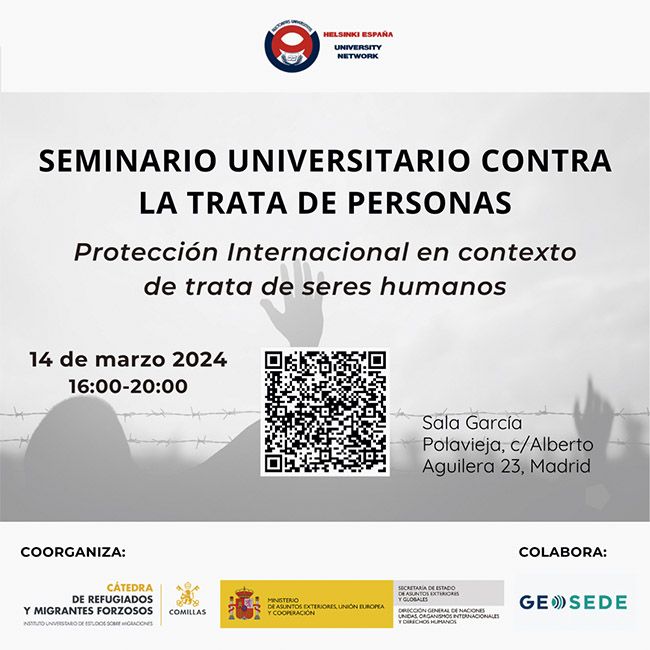
Helsinki Spain will hold the “Seminar on Migration and Refugee: International Protection in the Context of Human Trafficking,” a conference co-organized with the Chair of Refugees and Forced Migrants of the University Institute for Migration Studies (IUEM), in close collaboration with GEOSEDE, and with the support of the Ministry of Foreign Affairs, European Union and Cooperation.
During this event, we will delve into topics related to the complexity of human trafficking and its international implications. We will explore international protection strategies being implemented to combat it. In addition to the theoretical part led by experts in the field, the seminar will conclude with a debate on the issues raised during the day, aiming to foster the exchange of ideas, critical thinking, and promote enriched collective learning.
The seminar will take place on March 14, 2024, from 4:00 pm to 8:00 pm, at the García Polavieja Hall, located at 23 Alberto Aguilera Street, Madrid.
If you are interested in learning, reflecting, and contributing together to the fight against human trafficking, we invite you to register at the following link for more details and to secure your participation: registration link.
Oct 23, 2023 | Human Rights
Ignore the superficial similarities. This latest war between Israel and Hamas over Gaza – the sixth, and by far the most destructive, since 2005 – is unlike its predecessors in important ways. It’s also highly unlikely to end in the same way as before: the considerable destruction of homes and civilian infrastructure, an inconclusive military and political stalemate and a return to the status quo ante.
You might think you have seen this movie before, but you haven’t. We may be only watching the opening sequence, but one thing is already clear. No one, not Bibi Netanyahu, not Joe Biden, not Ismail Haniyeh, the Hamas leader, nor Ayatollah Khamenei, knows how the war is going to end.
As a shocked world witnessed on 17 October, when an explosion at the Al Ahli hospital in Gaza killed several hundred Palestinian civilians seeking refuge or being treated, the course of conflict can suddenly turn unexpectedly. Once an all-out war starts, it is often out of the hands of those who claim to be in charge. As I write, warning lights about regional escalation are already flashing.
Another sobering conclusion can also be drawn in these early days. The deepest, most existential, fears of Jews and Palestinians alike have been invoked. Like ghosts whose bodies were buried in graves that were too shallow, collective traumas have reemerged into the daylight. As emotions run high on both sides, racial delegitimization of the other is again appearing. Supposedly responsible Israelis describe Palestinians as animals to be killed. If they are to be able to live peaceful lives together once again, a hope that does not look likely in my lifetime, this kind of ugly rhetoric must be banished once and for all.
For Jews, the slaughter of innocents that took place on the war’s opening day, Saturday 7 October, in kibbutzim near the Gazan border fence evoked ancestral memories of antisemitic pogroms in Eastern Europe and the Nazi Holocaust. The fact that many of the kibbutz residents were peace activists committed to living in harmony with their Palestinian neighbours added to the bitter taste.
For Palestinians, Israel’s order to a million Gazans to leave their homes and move south, towards the Egyptian border and even into the Sinai desert, was a vivid reminder that their mass displacement in 1948, the Nakba, is not yet over. Egypt and Jordan fear that they may be obliged to bear the brunt.
Putting aside for a minute the tens of thousands of lives already lost or destroyed, a shockingly large percentage of them women and children, the biggest casualty so far has been respect for international humanitarian law and the rules of war. What has been astonishing is the casual disregard by both sides, especially by Israel, a powerful state that has ratified treaties and conventions governing military conduct in times of war, for the most basic principles.
What adds to my deep dismay is that Israel’s close allies in the West are today either tacitly or explicitly condoning grave breaches of law, many of which amount to war crimes. How it is possible for Western politicians to defend or justify the cutting-off of water, electricity, fuel, food, and medicine to an entire population of 2.3 million, to punish them for the sins of Hamas and oblige it to give up its hostages? This is hard to comprehend. The glaring moral disconnection between the pious statements the West makes constantly about Russia’s actions in Ukraine and what Israel is doing in Gaza does not seem to trouble them.
As any international lawyer knows, the taking of hostages as human shields or bargaining chips is absolutely prohibited by law. Hamas therefore has an obligation to surrender immediately all the civilians it is holding, starting with women, children, the elderly and the sick. Their illegal detention only gives Israel a further pretext for its threatened ground invasion. The legal situation of the Israeli soldiers Hamas captured is murkier; they could legitimately be considered as prisoners-of-war. Even so, they must be cared for, treated with respect, and returned safely to their homes once hostilities are over. The reverse is also correct. Israel holds some 7,000 Palestinian detainees, many of them without charges for years. A prisoner swap would be a good first step, as Qatar has begun trying to bring about.
From a humanitarian perspective, the top – and most urgent – priority must of course be a pause in the fighting to allow essential supplies to enter the Gaza Strip as many are demanding, especially in the Arab world. The lives of hundreds of thousands of Palestinians are at grave risk today from lack of food and water, or the disease.
What makes this demand uncomfortable for Western leaders to adopt publicly is that it runs directly counter to Israel’s war strategy, which is to deliberately put collective pressure on the whole population of Gaza, and force Hamas’ hand. In this regard, for days now, arm-wrestling has been taking place between Egypt backed by other Arab states on the one hand and Israel, supported by the United States and much of Europe on the other. Cries from the UN for humanity to prevail, in the midst of madness, have so far been ignored.
The stated goal of the Netanyahu government acting with overwhelming public support is to destroy Hamas militarily and politically. That objective is unrealistic and unlikely to succeed. Hamas and its smaller, more radical, sister organisation, Palestinian Islamic Jihad, represent a significant, and legitimate, part of Palestine’s political spectrum. This dangerous course of action is likely to cause other, previously unseen, monsters to emerge.
However unpalatable it may be to Western and Arab leaders who have attempted to ban them, over the decades Islamists have consistently received the support of 30 to 40 percent of the Palestinian electorate. A recent poll at Bir Zeit University in the West Bank, often considered a reliable indicator of the national mood, demonstrated that in any new general elections Hamas would convincingly defeat Fatah. The Israeli goal also conveniently overlooks the many Palestinians in the diaspora, especially in the refugee camps, who support Islamist groups of one kind or another. If Hamas were to disappear, another more violent jihadi organisation would likely take its place in the coming years.
If the currently foreseen course of events in and around Gaza is the wrong direction to take, what is the better alternative?
The answer comes in three parts. Meaningful international pressure must be put on Netanyahu not to proceed with a ground invasion and permanent occupation of northern Gaza, as is being threatened. This could act as the spark for a wider regional war that must be avoided. Second, Palestinians everywhere, not just in Israel and the occupied territories, must take their future in their own hands. The PLO and the broad national movement for freedom and independence must be revived from top-to-bottom. Nothing less will do. There can be no more shuffling of the deck chairs while the ship is burning.
Finally, the international community must assume its legal and moral responsibility for the wellbeing of the five and a half million Palestinians in the occupied territories, including East Jerusalem. Who will be capable of administering Gaza after the war is over is the big question of the moment. It cannot be the Fatah-led Palestinian Authority, which lacks any public legitimacy these days. It will be unable to rule the territory either by consent or force. Nor can there be another Israeli military occupation and administration; it would result in a popular uprising and continued guerrilla warfare.
The best (and most practical) option is to place the Gaza Strip under temporary international administration as was done with East Timor (a former Portuguese colony annexed by Indonesia) and in the Balkans after the break-up of the Yugoslav Republic. It should not be overlooked that the UN has a legal responsibility for Palestine, to find a lasting political solution that can end the Israeli occupation that began in 1967. The European Union, which has an important stake in the security of the region and has spent billions of Euros since the Oslo Accords on trying to build the institutions of a future Palestinian state, should also play a leading role.
There is a precedent. In 2005, then US Secretary of State Condoleezza Rice negotiated an Access and Movement Agreement covering the Gaza Strip with Israel, the PLO and Egypt. EU monitors were placed at the Rafah and Kerem Shalom crossings to inspect people and goods entering and leaving the territory, to build confidence on all sides. The agreement collapsed with the intra-Palestinian fighting of mid-2007 which led to Hamas’ full seizure of control over the territory.
With Hamas happy to hand back responsibility for administering Gaza to anyone willing to take it on, now is the moment to revive this plan, but on a much more ambitious scale. The temporary administration should be strictly timebound, limited perhaps to two years, and to a political timetable which would provide for fresh elections throughout the Palestinian territories.
Under new leadership, Palestinians stand a chance of a brighter future. In the meantime, the fighting must stop.
By Andrew Whitley, a member of Helsinki Espana’s Advisory Council and former senior UN official.